Quiz Entry - updated: 2026.10.22
How are the four principles applied to a concrete case, and what happens when they conflict?
In two steps: first interpret each principle for the specific situation of the case, then check whether the resulting obligations agree or conflict. If they conflict, weigh them for the situation, because there is no fixed ranking; the weighting must rest on reasons that others can follow, not on gut feeling.
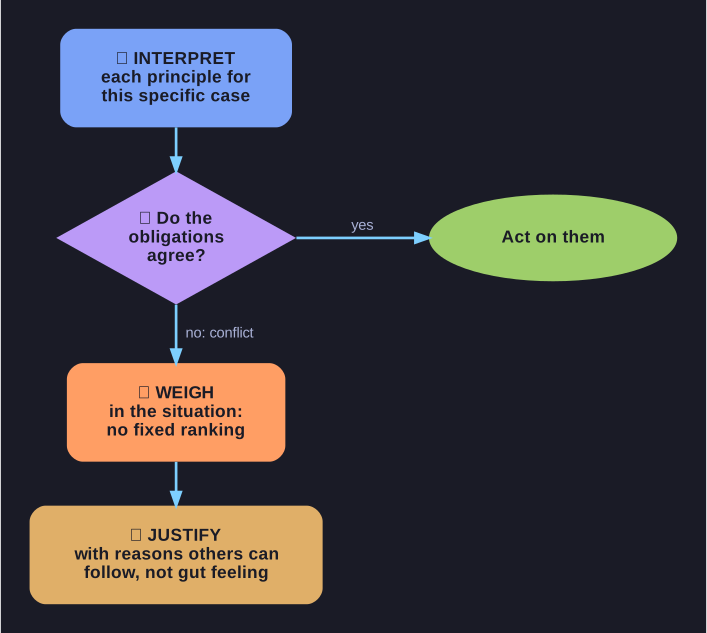
* Interpret, check for conflict, then weigh with stated reasons *
- Interpretation: what does each principle mean here? (e.g. what does respecting autonomy mean for a patient with advanced dementia?)
- Check for agreement: do the obligations from the principles point the same way? If yes, act on them.
- Weighting (Gewichtung) in case of conflict: the principles are prima facie, so none wins automatically. A limited harm can be required to prevent a greater one; self-determination can be limited by non-maleficence and beneficence (how far paternalistic intervention may go is disputed).
- Justify transparently: especially when a conflict cannot be fully resolved, the decision must be made comprehensible to others with reasons and arguments.
The principles are designed for one practice area (medicine), and they are socially accepted, which is what makes this procedure workable among people with different worldviews. Medical knowledge only says what we can do; this procedure is about what we should do.
Go deeper:
 Wikipedia: Principlism — specification and balancing of the principles.