Company B runs a business directory with a social-media-style marketplace on Azure, built with Blazor Server and SignalR. How does the application talk to the browser, and which company rule makes this a security case?
With Blazor Server the main logic runs on the server and the browser is a thin client: it loads only small pages, and all further updates travel over a SignalR connection, a WebSocket link between client and server. A company-wide policy demands that every web presence be protected by a web application firewall.
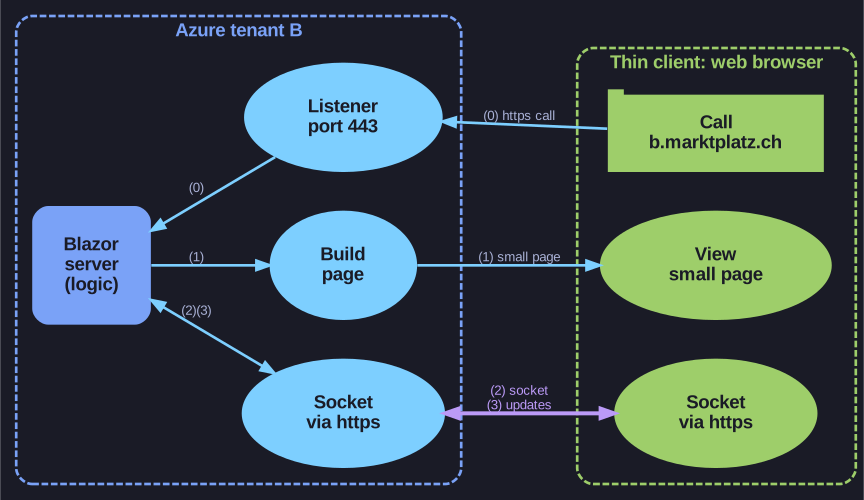
* After the first small page, everything runs over one long-lived socket rather than separate HTTP requests. *
The case: tradespeople register in the directory and offer their services on a digital marketplace; registered customers visit it and exchange messages with traders and with each other. Company B lives on the trust of its marketplace participants, so it takes cyber security seriously. The flow:
- (0) The user calls
https://b.marktplatz.ch; a listener on port 443 in B's Azure tenant accepts it. - (1) The Blazor server builds a small page and sends it to the browser.
- (2) The page opens a socket connection (WebSocket over HTTPS) back to the server.
- (3) All data transfer and UI updates flow over that socket in both directions.
Blazor is Microsoft's open-source framework for web applications and comes in several variants; Blazor Server is the one where the code stays on the server. SignalR is the open-source library that provides the WebSocket communication.
Go deeper:
 Microsoft Learn — ASP.NET Core Blazor hosting models — how Blazor Server keeps the code on the server and sends UI updates over SignalR.
- Microsoft Learn — Overview of ASP.NET Core SignalR — the real-time library and its transports.
- WebSocket — Wikipedia — the long-lived, two-way protocol behind the socket connection.