A cheese dairy's kitchen chef asks the network admin for "a network port for the new smart fridge". What does a system analysis of that fridge show about boundaries, actors and interaction?
The fridge is a cyber system, not just an appliance. Three systems each have their own boundary: the fridge (K-system), the smartphone running the vendor's SmartFrost app, and the vendor's SmartFrost server (S-system). The kitchen staff act on the fridge and the app; the fridge and the server are actors in both directions and exchange the operating state over the internet, in a direction nobody knows.
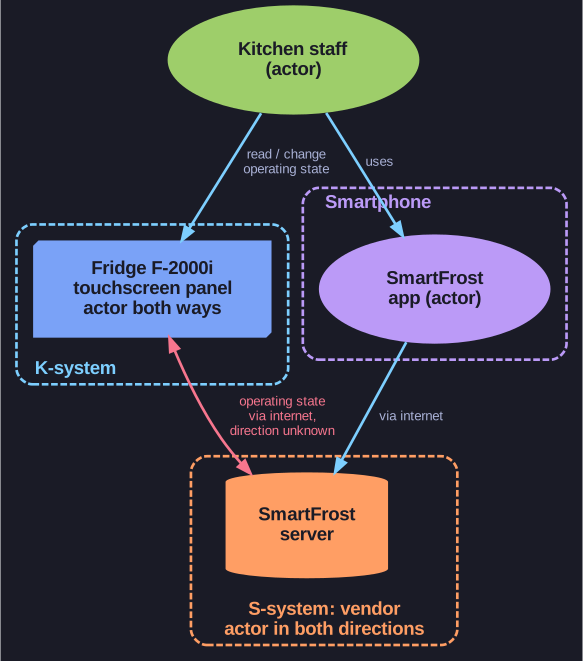
* Three systems, three boundaries: the fridge, the phone with the app, and the vendor's server, with the fridge-server link the unknown. *
The case. Cheese dairy K runs a canteen whose three-person kitchen team cooks lunch on working days. The kitchen fridge broke down, so there was no lunch. The kitchen chef (also the head cook) ordered a replacement, the F-2000i, which arrived within days. A network admin now comes to the security architect, puzzled: the chef wants "the network port for the fridge". What should happen?
What the vendor's material says. The F-2000i cools between +2 °C and +8 °C, has an electronic touchscreen panel and a "networking solution". Its smart feature lets you read and change the operating state from a smartphone and pushes alarms to the phone. You install the SmartFrost app, scan a QR code on the fridge and connect to the vendor's SmartFrost server. For all features, the fridge itself needs internet access. The dairy's network has a server LAN, workplace LANs, and a DMZ-LAN with web servers and a web proxy that leads to the internet.
The analysis:
- Systems and boundaries: the fridge, the smartphone with the app, and the vendor server.
- Actors: the kitchen staff and the app; the fridge and the server act in both directions.
- Interaction: staff read and change the state at the touchscreen or through the app; the app talks to the server over the internet; the server and the fridge exchange the operating state over the internet.
Because the app can change settings, outside commands may reach the fridge. That is why the unknown direction of the fridge-server link is the key question.
Go deeper:
 Smart refrigerator — Wikipedia — what connected fridges do, and a security section with a fridge that sent spam.
- NIST IR 8259A — IoT Device Cybersecurity Capability Core Baseline — the security features a networked device like this should offer.